



MacroOct 2, 2026 · 14 min read

Discover how AI trading bots and automated trading work in this comprehensive guide. Learn smart money strategies, analyze data, and automate your trading.
TradingWizard AI8 min read
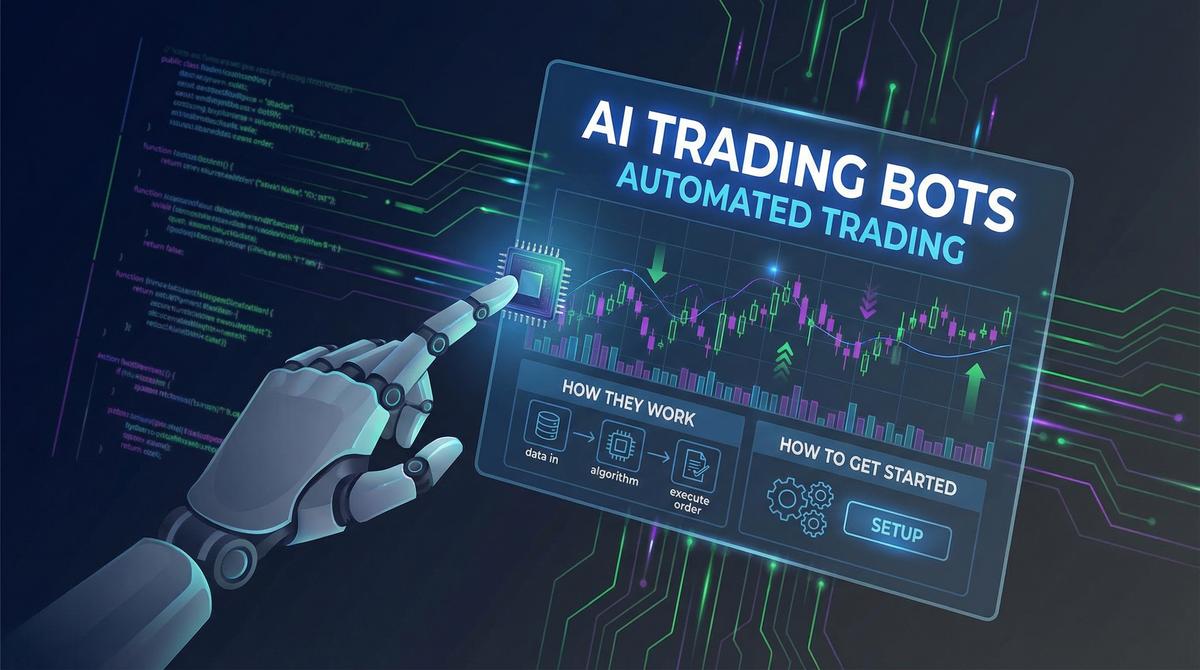
The landscape of financial markets has fundamentally shifted. Gone are the days when floor traders screaming in trading pits dictated market movements. Today, the modern tape is read, analyzed, and traded by machines in milliseconds. For retail traders and aspiring quants, understanding AI Trading Bots and Automated Trading is no longer optional—it is a critical prerequisite for survival in a market dominated by algorithmic liquidity.
If you want to trade like the "Smart Money," you must adopt their tools. This comprehensive guide will dissect the mechanics of AI trading bots and automated trading, examine the underlying data processing models, analyze probabilistic strategy scenarios, and provide you with an actionable roadmap to deploy your first automated system.
The democratization of institutional-grade technology has sparked a revolution. Historically, algorithmic trading was the exclusive domain of multi-billion-dollar hedge funds operating out of heavily guarded server farms in lower Manhattan. They leveraged proximity hosting and deep quantitative teams to scalp fractions of a cent.
However, the recent explosion in open-source machine learning models, accessible cloud computing, and robust exchange APIs has leveled the playing field. Today, AI trading bots and automated trading systems account for an estimated 70% to 80% of total trading volume in U.S. equity markets and an increasingly dominant share in the cryptocurrency sector.
Why does this matter right now? Because human emotion is the single greatest destroyer of alpha. Fear, greed, fatigue, and hesitation cause discretionary traders to deviate from their trading plans, leading to suboptimal execution and devastating drawdowns. AI trading bots eliminate the psychological burden of trading. They operate relentlessly, scanning thousands of assets simultaneously, backtesting hypotheses in seconds, and executing complex, multi-leg orders with absolute precision.
By transitioning from a discretionary trader to a system manager, you elevate your role from participating in the noise to orchestrating the signal.
To effectively deploy automated systems, you must first understand how they see the market. AI trading bots and automated trading algorithms do not look at charts the way humans do; they ingest, parse, and react to massive data arrays. Let us break down the three primary data pillars these bots rely upon.
Basic automated trading relies on rigid, rule-based parameters (e.g., "If the 50-day SMA crosses above the 200-day SMA, execute a market buy"). While functional, this is not true AI.
Modern AI trading bots utilize sophisticated machine learning architectures, such as Long Short-Term Memory (LSTM) networks and Random Forests, to analyze non-linear technical data. These models process historical price action, volume profiles, and order book depth (Level 2 data) to identify hidden correlations that human eyes cannot detect. They don't just react to indicators; they predict the statistical probability of the next price candle based on complex historical pattern recognition.
In the cryptocurrency and decentralized finance (DeFi) spaces, automated bots have an edge entirely unavailable in traditional finance: transparent, real-time on-chain data.
Advanced bots scan the mempool (the waiting area for unconfirmed blockchain transactions) to front-run large orders—a controversial practice known as Maximum Extractable Value (MEV). More accessible bots track whale wallet movements, monitor exchange inflows/outflows, and analyze smart contract interactions. If a bot detects a sudden spike in stablecoin deposits to a major derivatives exchange, it can preemptively position itself for an impending volatility expansion.
Markets are forward-looking mechanisms driven by macroeconomic data and central bank policy. AI trading bots digest this information via Natural Language Processing (NLP).
When the Bureau of Labor Statistics releases CPI data, or when the Federal Reserve Chairman steps to the podium, NLP-powered bots instantly scrape Bloomberg terminals, Reuters feeds, and financial Twitter. They analyze the sentiment of the text (hawkish vs. dovish, positive vs. negative) and execute trades in fractions of a second—long before a human trader has even finished reading the headline. This capability ensures that automated systems are always positioned correctly when macroeconomic shocks trigger immense liquidity sweeps.
Deploying a bot without understanding the current market regime is a recipe for catastrophic capital loss. Bots are tools, and like any tool, they are designed for specific environments. Here is a "Smart Money" scenario analysis of the most common automated strategies, their ideal market conditions, and their respective probabilities of success.
We must objectively address the risks. The "bear case" for relying solely on AI trading bots and automated trading stems from two primary dangers:
Transitioning from manual execution to automated systems requires a methodical approach. Do not rush to plug an API key into a random algorithm you found on a forum. Follow these actionable steps to build a robust, institutional-grade automated trading framework.
Before writing a line of code or subscribing to a bot service, clearly define your strategy. Are you attempting to scalp micro-trends on the 1-minute chart, or swing-trade daily support/resistance zones? Define your maximum allowable drawdown per trade (e.g., 1% of account equity) and your target Sharpe ratio. A bot is only as intelligent as the parameters set by its creator.
You do not need a Ph.D. in computer science to participate in AI trading bots and automated trading.
This is where retail traders fail and smart money thrives. Backtest your strategy across multiple years of historical data, encompassing bull markets, bear markets, and sideways chop. Look for the Maximum Drawdown (Max DD) and Profit Factor.
Once the backtest is profitable, you must forward test it. Connect the bot to a paper trading account and let it run on live data for at least 30 to 60 days. This step verifies that your system isn't suffering from execution latency or catastrophic slippage.
When you are ready to go live, generate API keys from your exchange. Crucial Security Rule: Never enable "Withdrawal" permissions on your API keys. Only grant the bot "Read" (to view balances and chart data) and "Trade" (to execute orders) permissions. Start with a small fraction of your capital to ensure the bot behaves exactly in live conditions as it did in paper trading.
The financial markets are evolving into a high-speed, data-driven ecosystem. Refusing to adapt to the reality of AI trading bots and automated trading is akin to bringing a knife to a gunfight. By understanding the data streams these algorithms utilize—from complex machine learning on technical indicators to NLP sentiment analysis on macroeconomic news—you can position yourself alongside the smart money.
Whether you decide to build a Python-based statistical arbitrage model from scratch or utilize intuitive, pre-built automation platforms, the goal remains the same: remove human emotion, strictly manage risk, and let the data dictate the execution.
Ready to stop staring at charts all day and start trading like a machine? TradingWizard.ai provides the ultimate suite of tools for the modern trader.
Don't let the algorithms beat you—command them. Visit TradingWizard.ai today and transform your trading from an emotional gamble into an automated, data-driven enterprise.
MacroOct 2, 2026 · 14 min read
MacroSep 30, 2026 · 12 min read
MacroSep 28, 2026 · 11 min read
MacroSep 25, 2026 · 12 min read