



MacroOct 5, 2026 · 13 min read

Discover how Smart Money dominates the markets in our comprehensive guide to AI trading bots, automated systems, and algorithmic strategy development.
TradingWizard AI8 min read
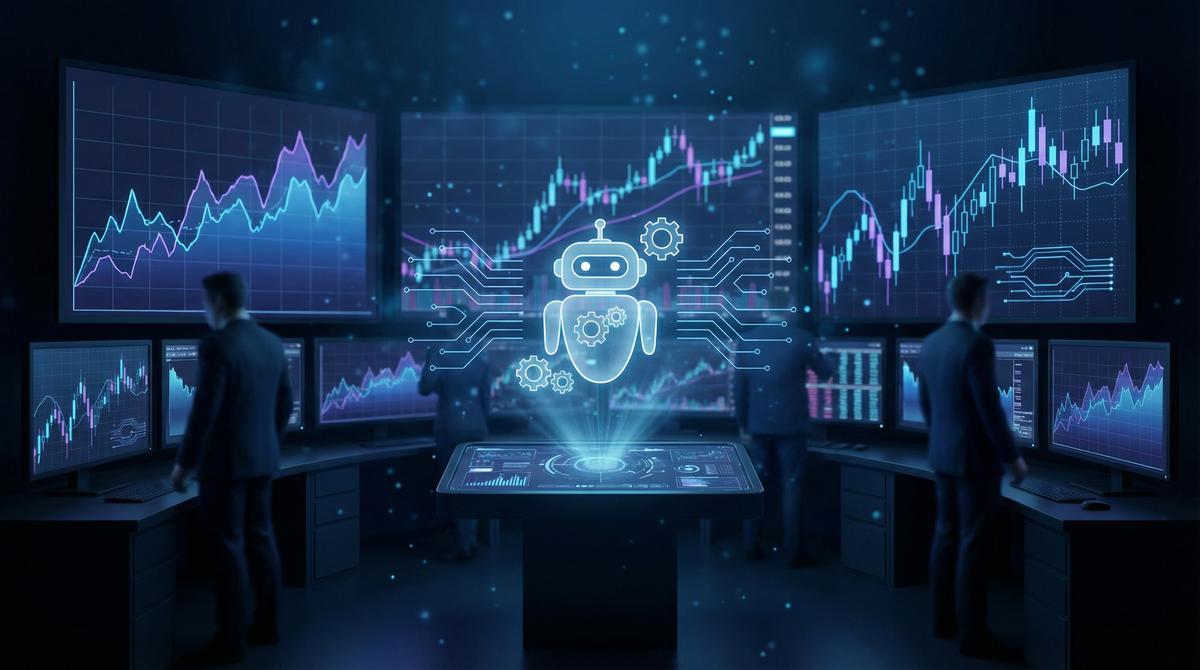
The financial markets have undergone a profound paradigm shift. The days of shouting orders across a chaotic trading pit are long gone, replaced by silent, humming servers housed in data centers mere miles from exchange matching engines. For the modern retail trader, bringing manual point-and-click strategies to today's market is akin to bringing a knife to a gunfight.
Welcome to Algorithmic Trading Explained: A Comprehensive Guide to Using AI Trading Bots and Automated Systems. Whether you are trading equities, forex, or digital assets, the tape is now dominated by lines of code rather than human intuition. In this comprehensive guide, we will break down the mechanics of algorithmic trading, explore how artificial intelligence is reshaping quantitative strategies, and provide you with actionable steps to build your own automated edge.
To understand why algorithmic trading is essential, we must first look at the modern market structure. Currently, it is estimated that between 70% to 80% of all trading volume in the U.S. equity markets is executed by automated systems. In the 24/7 cryptocurrency markets, that number is arguably higher, driven by market makers, arbitrageurs, and high-frequency trading (HFT) firms.
Why does this matter to you? Because the "Smart Money"—institutional quants, hedge funds, and proprietary trading firms—relies entirely on algorithmic execution to extract alpha from the market.
Human traders suffer from three terminal flaws: emotion, fatigue, and latency. Fear and greed dictate poor risk management; sleep requirements mean missed opportunities in global markets; and human reaction times simply cannot compete with an algorithm that executes a multi-leg options strategy or a cross-exchange crypto arbitrage in milliseconds.
Understanding algorithmic trading explained: a comprehensive guide to using AI trading bots and automated systems is no longer just for Ivy League mathematicians. With the democratization of APIs, cloud computing, and consumer-facing AI tools, retail traders now have the infrastructure to deploy sophisticated algorithmic strategies. The barrier to entry has evaporated, leaving only a barrier of knowledge.
To build a robust automated system, one must understand the inputs that drive the logic. Smart algorithmic trading bots do not just buy and sell blindly; they synthesize vast amounts of market data in real-time. Let’s break down the three core data pillars automated systems use to generate trade signals.
Algorithms excel at processing macroeconomic data faster than humanly possible. When the Federal Reserve releases CPI data or interest rate decisions, AI bots utilize Natural Language Processing (NLP) to read and interpret the text of the press release within microseconds.
If the data prints dovish (favorable for risk assets), bots instantly route "buy" orders across equities and crypto markets before a human trader has even finished reading the headline. Furthermore, automated systems monitor macro liquidity conditions, adjusting their risk parameters based on bond yields, the DXY (US Dollar Index), and systemic volatility (VIX). An intelligent trading bot will automatically scale down position sizes when macro volatility breaches a predefined historical threshold, protecting capital during systemic shocks.
At the core of most retail and proprietary trading bots lies technical analysis. However, unlike human traders who "feel" support and resistance, an algorithm requires strict mathematical definitions. Here are the most common technical strategies employed by automated systems:
In the cryptocurrency space, AI trading bots have a unique playground: the blockchain. Because crypto networks are public ledgers, automated systems can scan on-chain data for predictive signals.
Advanced bots track "whale" wallets. If a dormant wallet holding 10,000 BTC suddenly transfers its balance to a known Binance deposit address, an automated system will instantly interpret this as impending sell pressure and automatically hedge the portfolio by shorting Bitcoin futures.
Additionally, modern AI systems integrate alternative data, such as scraping Twitter/X, Reddit, and Discord for social sentiment. By utilizing advanced machine learning models, bots can gauge whether retail sentiment on a specific altcoin is euphoric or capitulatory, feeding this data into a broader probabilistic model to determine the optimal entry or exit point.
Understanding the theory is only half the battle. To successfully deploy an AI trading bot, you must treat your trading as a quantitative business. Here is the actionable, step-by-step framework the Smart Money uses to build automated systems.
Your bot needs a strict set of rules. A poorly defined ruleset will result in a bot that aggressively loses money. You must mathematically define:
Before risking a single dollar, you must run your algorithm against historical data. Backtesting answers a critical question: Would this strategy have made money in the past?
When evaluating backtest results, do not just look at total profit. Professional quants focus on:
Historical success does not guarantee future results due to a phenomenon called "curve fitting" (over-optimizing a bot to perfectly match past data, rendering it useless in live, dynamic markets). Forward testing involves running the bot in real-time with fake money. This allows you to verify that the bot processes live data, executes orders without API lag, and handles current market volatility as expected.
As objective market analysts, we must evaluate the probabilities of success and failure when adopting automated trading systems.
If built and managed correctly, the bull case for algorithmic trading is absolute outperformance of discretionary retail traders. The primary advantage is emotionless execution. Human traders routinely break their own rules—moving stop losses out of hope or taking profits too early out of fear. A bot simply executes the math.
Furthermore, an automated system can monitor 500 different trading pairs simultaneously across multiple timeframes, 24 hours a day. It scales your ability to find setups infinitely. In a market regime that favors a specific strategy (e.g., a strong trending bull market), an automated trend-following bot will capture almost every major move, compounding capital at a rate unmatchable by a human staring at a single monitor.
The bear case for algorithmic trading usually stems from human error in the bot's creation. The most common trap is "over-optimization." A trader might tweak their bot's parameters so aggressively during backtesting that it achieves a 95% win rate on historical data. However, the moment market conditions change, the heavily rigid bot collapses, resulting in severe capital loss.
Additionally, automated systems are vulnerable to systemic black swan events and technical failures. Flash crashes can trigger a cascade of algorithmic stop-losses, resulting in massive slippage. API connection drops between the bot and the exchange can leave positions unmanaged during volatile swings. Automation does not mean "set it and forget it"—it requires constant monitoring and recalibration of risk parameters.
The verdict is clear: manual retail trading is becoming obsolete in a market dominated by institutional algorithms. Embracing automation is no longer a luxury; it is a prerequisite for survival and consistent profitability. By removing human emotion, enforcing strict risk management via code, and leveraging the speed of AI to process macro, technical, and on-chain data, you position yourself alongside the Smart Money rather than acting as their exit liquidity.
However, building these systems from scratch requires significant coding knowledge and infrastructure. You don't have to navigate this complex transition alone.
Ready to automate your edge? With TradingWizard.ai, you gain access to institutional-grade tools without needing a degree in computer science. Deploy our pre-built, customizable AI Trading Bots, utilize our advanced Chart Analyzer to backtest your technical logic, and set up real-time Smart Alerts to keep you ahead of the order flow. Stop competing against machines manually—let TradingWizard build the machine for you. Start your automated trading journey today and reclaim your advantage in the markets.
MacroOct 5, 2026 · 13 min read
MacroOct 2, 2026 · 14 min read
MacroSep 30, 2026 · 12 min read
MacroSep 28, 2026 · 11 min read