



Macro
Fed Rate-Cut Expectations Reprice Treasury Yields and the US Dollar
Sep 19, 2026 · 12 min read
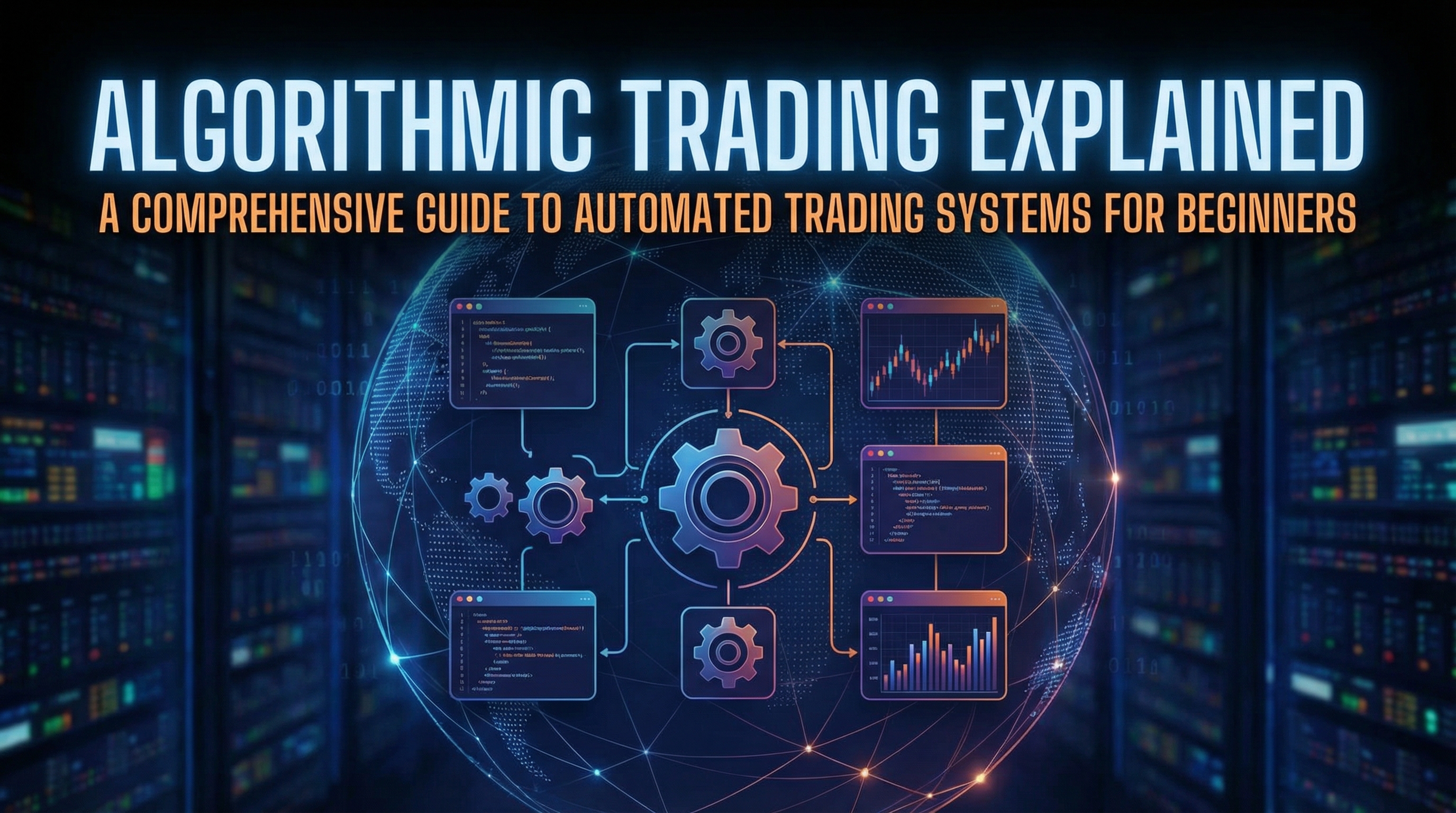
Discover how algorithmic trading works in this comprehensive guide to automated trading systems for beginners. Learn strategies, risks, and how to start.
March 30, 2026 · 10 min read · TradingWizard AI

For decades, the financial markets were dominated by men in tailored suits yelling on trading floors. Today, those floors are largely silent. The real action happens in the hum of server racks located mere miles from major exchanges. If you are a retail trader manually clicking "buy" and "sell" based on gut feeling, you are bringing a knife to a gunfight.
Welcome to Algorithmic Trading Explained: A Comprehensive Guide to Automated Trading Systems for Beginners. In the modern market ecosystem, automation is no longer a luxury reserved for Wall Street quantitative hedge funds; it is an absolute necessity for anyone looking to extract consistent alpha.
Why does this matter right now? We are living in an era of unprecedented data democratization and artificial intelligence. Retail traders now have access to cloud computing, institutional-grade APIs, and powerful on-chain data that was previously locked behind million-dollar paywalls. By learning to deploy automated trading systems, beginners can strip away the psychological pitfalls of trading—fear, greed, and hesitation—and execute strategies with cold, calculated precision.
In this comprehensive guide, we will break down exactly how algorithmic trading works, dive deep into the data driving these automated engines, explore practical strategies you can deploy today, and weigh the probabilistic scenarios of running your own trading bots.
At its core, algorithmic trading (often called algo trading or black-box trading) is the process of using computers programmed to follow a defined set of instructions (an algorithm) for placing trades. The goal is to generate profits at a speed and frequency that is impossible for a human trader.
The defined sets of instructions are based on timing, price, quantity, or any mathematical model. Apart from profit opportunities, automated trading systems render markets more liquid and make trading more systematic by ruling out the impact of human emotions on trading activities.
For beginners, it is crucial to understand that an algorithm is not a crystal ball. It is simply a set of rules. A robust automated trading system consists of four primary pillars:
To understand why you need to embrace automation, we must look at the data. The "Smart Money" does not rely on intuition; they rely on statistical edges proven over thousands of iterations.
According to recent market reports, algorithmic trading accounts for roughly 70% to 80% of the overall trading volume in U.S. equity markets. In the cryptocurrency space, automated trading systems drive an estimated 85% of perpetual futures volume. If you are trading manually, you are the liquidity for these machines.
Human reaction time to visual stimuli (like a chart breaking out) is approximately 250 milliseconds. Conversely, an optimized algorithmic system connected via WebSockets to an exchange can parse data, make a decision, and execute a trade in under 5 milliseconds. In volatile markets, that 245-millisecond difference is the difference between catching a breakout and buying the top.
Modern automated trading systems for beginners are no longer limited to simple price charts. Today's APIs allow you to feed your algorithms complex datasets:
When exploring algorithmic trading explained, it is essential to look at the practical applications. You do not need a Ph.D. in mathematics to build a profitable bot. Here are the most accessible strategies for beginners building automated trading systems.
This is the most common algorithmic trading strategy. The bot follows market trends based on technical indicators like Moving Averages (MA), Breakouts, or Price Level Movements.
The core philosophy here is that asset prices, over time, revert to their historical average. If a price deviates too far from the mean, the algorithm bets it will snap back.
While not a strategy to generate alpha per se, Volume Weighted Average Price (VWAP) and Time Weighted Average Price (TWAP) are crucial automated systems for executing large orders without moving the market.
This strategy involves buying an asset on one exchange while simultaneously selling it on another where the price is higher.
The allure of automated trading systems is strong, but the graveyard of retail traders is filled with bots that looked great on paper but blew up in live markets. The most critical step in algorithmic trading is Backtesting—running your rules against historical data to see how they would have performed.
However, beginners often fall into the trap of Curve Fitting (Over-optimization). This happens when you tweak the parameters of your algorithm so specifically to past data that it achieves a 100% win rate historically, but completely fails in real-time trading because it lacks adaptability.
Actionable Advice for Robust Backtesting:
When deploying automated trading systems, professional quants think in probabilities. Let's analyze the likely scenarios when you turn your first algorithm on.
The Smart Money Takeaway: The difference between the bull and bear scenario is not the magic of the entry signal. It is the robustness of the risk management logic. Professional systems have logic that dictates: "If the bot experiences 5 consecutive losses, or volatility spikes above the 90th percentile, pause all trading and send an alert to the operator."
Ready to transition from manual clicking to automated mastery? Here is the Smart Money blueprint to getting started:
Understanding algorithmic trading is the single most important step you can take to elevate your market performance from a gambling retail participant to a systematic operator. The "Smart Money" does not rely on luck; they rely on math, speed, and unshakeable discipline. Automated trading systems offer beginners a profound opportunity to level the playing field, provided they respect the rigorous process of backtesting and risk management.
Remember, an algorithm will not make a bad strategy profitable. But an algorithm will execute a good strategy perfectly, devoid of the fear and greed that bankrupts human traders. Start small, test relentlessly, and let the data guide your path to consistent alpha.
Ready to stop trading on emotion and start trading like the Smart Money?
Level up your market execution with TradingWizard.ai. Build, backtest, and deploy powerful automated trading systems without the headache. Utilize our advanced Chart Analyzer to uncover hidden patterns, set up real-time institutional-grade Alerts, and connect our cutting-edge Trading Bots directly to your exchange to execute your edge 24/7. Don't fight the machines—command them. Start your journey with TradingWizard.ai today.
Sep 19, 2026 · 12 min read
Sep 18, 2026 · 15 min read
Sep 17, 2026 · 12 min read
Sep 16, 2026 · 11 min read
14 days free. No card.
Trading involves risk. Bots trade a Demo account with simulated money. Nothing here is investment advice.