



Macro
Fed Rate-Path Repricing: How U.S. Labor Data Changes the Trade
Sep 18, 2026 · 15 min read
Discover how algorithmic trading works for beginners in this comprehensive guide to AI trading bots. Learn data strategies, risk management, and smart money tactics.
March 25, 2026 · 9 min read · TradingWizard AI

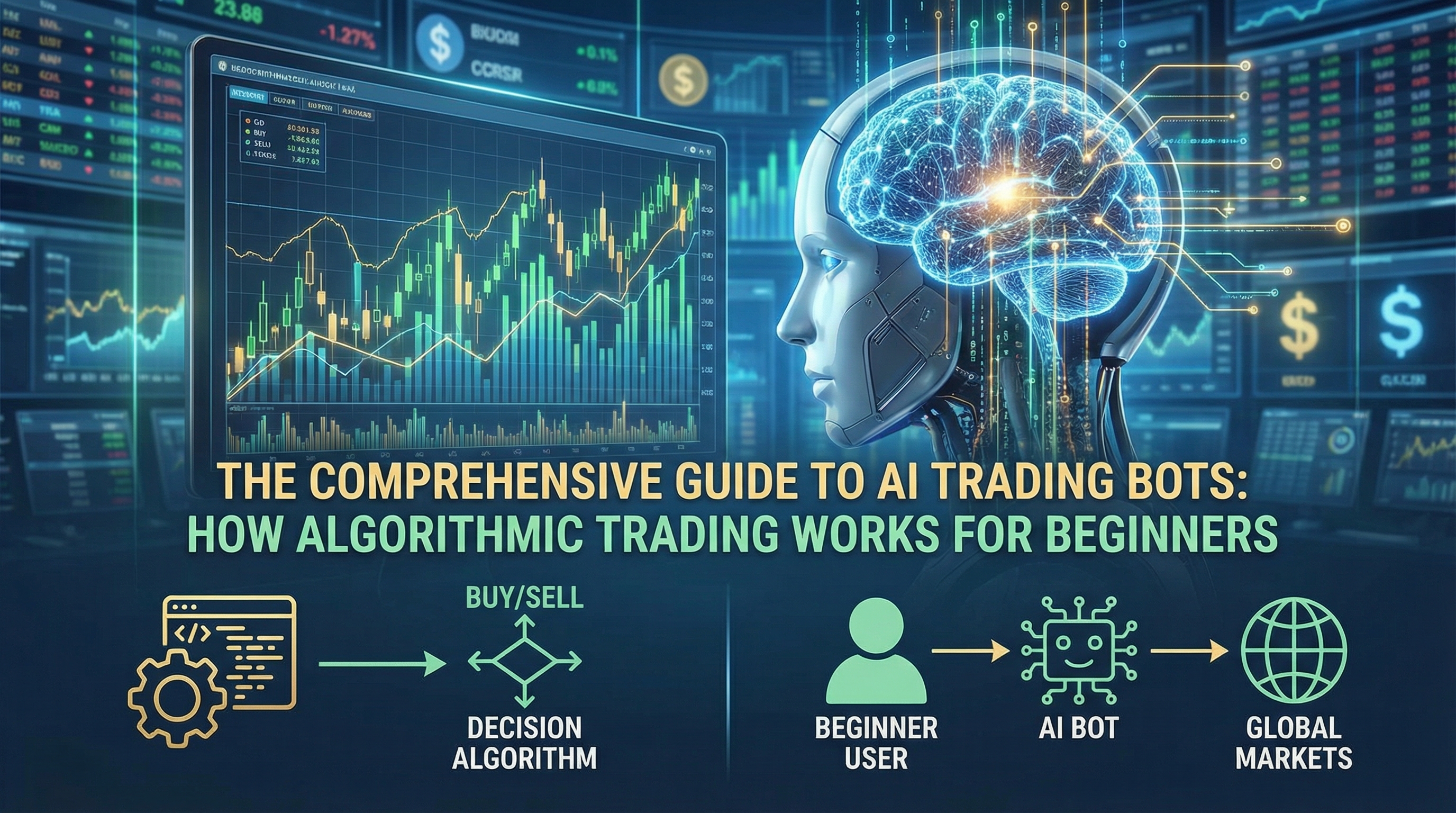
For decades, the world's most profitable financial institutions—firms like Renaissance Technologies and Two Sigma—have relied on heavily guarded, computationally massive automated systems to extract billions of dollars from the global markets. Historically, this "Smart Money" edge was locked behind multi-million-dollar server racks co-located inside the New York Stock Exchange. Today, the landscape has fundamentally shifted. Welcome to The Comprehensive Guide to AI Trading Bots: How Algorithmic Trading Works for Beginners.
In the modern financial era, algorithmic trading accounts for over 70% of all equity market volume, and in the 24/7 cryptocurrency markets, that number is estimated to be even higher. The barrier to entry has evaporated. Thanks to the democratization of machine learning, cloud computing, and open-source APIs, retail traders can now deploy sophisticated automated strategies from their laptops.
But what exactly separates a profitable algorithmic system from a portfolio-draining script? Why do some traders sleep soundly while their bots generate alpha, while others wake up to liquidated accounts?
If you want to understand how algorithmic trading works for beginners, you must first abandon the myth of the "money-printing machine." AI trading bots are not magic; they are rigorous, data-driven execution engines. They require logic, constant optimization, and an ironclad understanding of risk management. In this comprehensive guide, we will pull back the curtain on how AI and algorithmic trading truly function, how they ingest market data, and how you can begin building your own automated edge.
To understand how algorithmic trading works for beginners, you must understand its core currency: Data. Human traders are inherently limited by biology. We can only look at a few charts at once, our reaction times are capped at a few hundred milliseconds, and our judgment is clouded by fear, greed, and fatigue.
An AI trading bot, conversely, can simultaneously process thousands of data streams across multiple timeframes, executing decisions based on pure probability. Here is the Smart Money breakdown of how bots interpret the three main pillars of market data.
Beginner traders often use basic conditional logic (heuristics) for their first bots: "If the Relative Strength Index (RSI) crosses below 30, and the Moving Average Convergence Divergence (MACD) crosses bullishly, execute a buy order."
While this is a valid form of algorithmic trading, true AI trading bots go much deeper. Modern machine learning models utilize what is known as feature engineering to find invisible correlations.
In the cryptocurrency market, the blockchain serves as a transparent ledger of all market activity. AI trading bots are uniquely positioned to exploit this data in ways human traders simply cannot.
This is where AI truly separates itself from traditional algorithmic scripts. The "Holy Grail" of modern automated trading is unstructured data analysis.
If you are reading The Comprehensive Guide to AI Trading Bots, you need to understand the structural architecture of a trading system. Every successful algorithmic trading bot follows a strict four-step pipeline.
Bots do not log into brokerage websites. They connect directly to the exchange's matching engine via APIs (Application Programming Interfaces). For low-latency data (tick data), they use WebSockets to receive a continuous, real-time stream of price updates.
This is the strategy layer. Once the data is ingested, the bot's algorithm processes it to look for "Alpha"—a statistical edge. This could be a mean-reversion strategy (buying an asset when it deviates too far from its moving average) or a momentum strategy (buying breakouts). In Machine Learning models, the bot uses historical data to predict the probability of the next price movement.
Smart Money knows that alpha generation is useless without capital preservation. The risk management layer dictates position sizing based on the Kelly Criterion, calculates portfolio heat, and sets hard stop-losses. A well-coded bot will automatically halt trading if a maximum daily drawdown limit is reached, protecting the user from "flash crashes" or systemic API errors.
Once the signal is generated and risk parameters are met, the execution layer sends the order payload to the exchange. Advanced execution algorithms (like TWAP - Time-Weighted Average Price, or VWAP - Volume-Weighted Average Price) slice large orders into smaller chunks to avoid slippage and hide their intentions from the broader market.
No trading system is infallible. A crucial part of learning how algorithmic trading works for beginners is understanding the environments where bots thrive, and where they fail. In quantitative finance, we call this regime detection.
The Setup: The market is in a sustained macroeconomic uptrend or downtrend, characterized by high volume and clean technical levels.
Bot Performance: Exceptional. Trend-following bots (using moving average crossovers and momentum oscillators) thrive here. Because human traders often take profits too early out of fear, an AI bot ruthlessly lets its winners run, using dynamic trailing stops to capture the absolute maximum out of a directional move. In high-volatility environments, Grid Trading bots and Statistical Arbitrage bots also print consistent returns by capitalizing on rapid, micro-price oscillations.
The Setup: The market is trapped in a tight, low-volume consolidation range, or a sudden macroeconomic shock (a "Black Swan" event like a global pandemic or a major exchange collapse) shatters technical correlations.
Bot Performance: Dangerous. In choppy markets, trend-following bots suffer "death by a thousand cuts," constantly buying false breakouts and getting stopped out (whipsawed). During Black Swan events, historical data models break down. If an AI bot is over-leveraged and lacks hard-coded circuit breakers, it can liquidate an account in minutes during a flash crash.
Smart Money Rule: Always code a "kill switch" into your automated systems that halts trading when market volatility exceeds a 3-sigma standard deviation.
Reading The Comprehensive Guide to AI Trading Bots is only the first step. Execution is what matters. If you are ready to implement algorithmic trading into your portfolio, follow this Smart Money blueprint:
The financial markets are an arena of highly optimized predators. Discretionary trading based solely on "gut feeling" and manually drawing lines on a chart is rapidly becoming an antiquated approach. AI trading bots represent the next evolution of market participation, stripping away emotional bias and replacing it with relentless, probabilistic execution.
However, automation is an amplifier. It will amplify a winning strategy, but it will also efficiently and ruthlessly amplify a losing one. Education, rigorous testing, and strict risk management are your only shields.
Ready to upgrade your trading strategy and trade alongside the Smart Money?
Stop fighting the algorithms and start commanding them. Head over to TradingWizard.ai today. From our drag-and-drop automated bot builders and advanced AI Chart Analyzer, to our real-time smart money alerts, TradingWizard provides the institutional-grade tools you need to build, test, and deploy your algorithmic edge. The revolution is automated. Make sure you're on the right side of the trade.
Sep 18, 2026 · 15 min read
Sep 17, 2026 · 12 min read
Sep 16, 2026 · 11 min read
Sep 13, 2026 · 13 min read
14 days free. No card.
Trading involves risk. Bots trade a Demo account with simulated money. Nothing here is investment advice.