


MacroOct 2, 2026 · 14 min read

Discover the mechanics behind algorithmic trading, how AI analyzes market structure, and real-world examples of machine learning in today's markets.
TradingWizard AI4 min read

For decades, institutional "Smart Money" has dominated the financial markets using advanced quantitative algorithms, leaving retail traders to fight an uphill battle armed with lagging indicators and emotional biases. But the landscape has irrevocably shifted. The democratization of artificial intelligence has brought institutional-grade analytics directly to the retail arena.
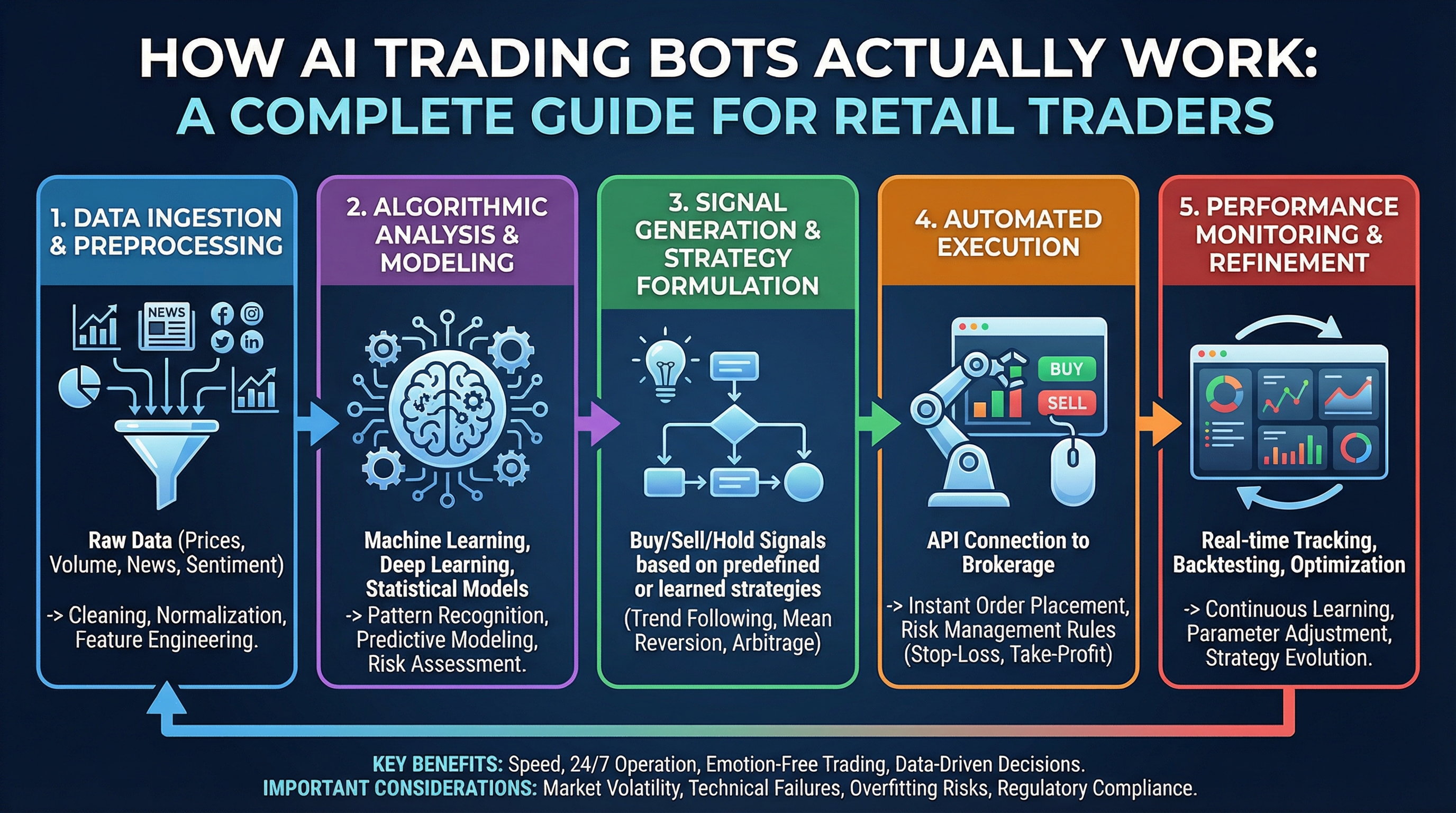
However, a dangerous misconception persists: many believe AI trading bots are magical "money-printing" black boxes. In reality, successful AI trading is built on probability models, structural mapping, and rigorous risk management. Human traders fail because of FOMO, revenge trading, and fatigue. AI trading bots succeed because they are ruthlessly objective. They don't predict the future; they execute high-probability scenarios based on historical data, real-time macro-economic factors, and complex technical structures.
In this guide, we're pulling back the curtain. Using live, real-time data from the TradingWizard.ai Engine, we will dissect exactly how a modern AI bot processes the market, navigates market cycles, and executes trades.
Modern AI trading systems ingest millions of data points across technicals, on-chain metrics, and macro-economic indicators. Here is how our AI parses live market conditions today:
An AI bot doesn't just look at a single timeframe; it maps market structure from the top down. When analyzing major forex pairs and indices, the bot hunts for structural breaks and demand zones.
While humans struggle with subjective drawing tools, AI calculates exact mathematical retracements and liquidity pools to find high-probability "Golden Zones."
One of the most critical, yet misunderstood, aspects of AI trading is knowing when not to execute. Volatile crypto markets often present incomplete or rapidly fragmented data that can confuse standard algorithms.
Based on the AI's current structural mapping—specifically the strength of the U.S. Dollar (DXY)—we can project two high-probability market scenarios for the coming week:
The "Dollar Dominance" Execution: The DXY fulfills the AI's projection, successfully pushing toward the 107.15 liquidity target. In this environment, algorithmic capital rotates heavily into dollar-quoted shorts, while pairs like GBPJPY maintain strength purely on localized cross-pair demand and Yen weakness. Traders utilizing AI will let the bot scale into structural pullbacks on DXY-correlated assets.
The "Macro Rejection" Execution: If DXY fails to hold the 106.15 support—perhaps due to an unexpected macroeconomic catalyst—the AI's dynamic models will instantly invalidate the bullish thesis. The bot will immediately cease buying DXY and EURCAD, pivoting to scan for short entries as retail traders are left holding the bag on a false breakout.
The gap between retail and institutional traders is closing, but tools only work if you understand how to use them. AI trading bots do not eliminate risk; they systematize it. By leaning on machine learning for structural mapping (like our EURCAD breakout), precision liquidity entries (our GBPJPY Golden Zone), and strict computational boundaries (halting on LTC and OP noise), traders can finally completely strip emotion from their execution.
To survive the modern markets, you must trade like a machine. Stop guessing. Start processing.
Trade smart. Trade systematically. Let the AI do the heavy lifting.
MacroOct 2, 2026 · 14 min read
MacroSep 30, 2026 · 12 min read
MacroSep 28, 2026 · 11 min read
MacroSep 25, 2026 · 12 min read