



Macro
Fed Rate-Path Repricing: How U.S. Labor Data Changes the Trade
Sep 18, 2026 · 15 min read
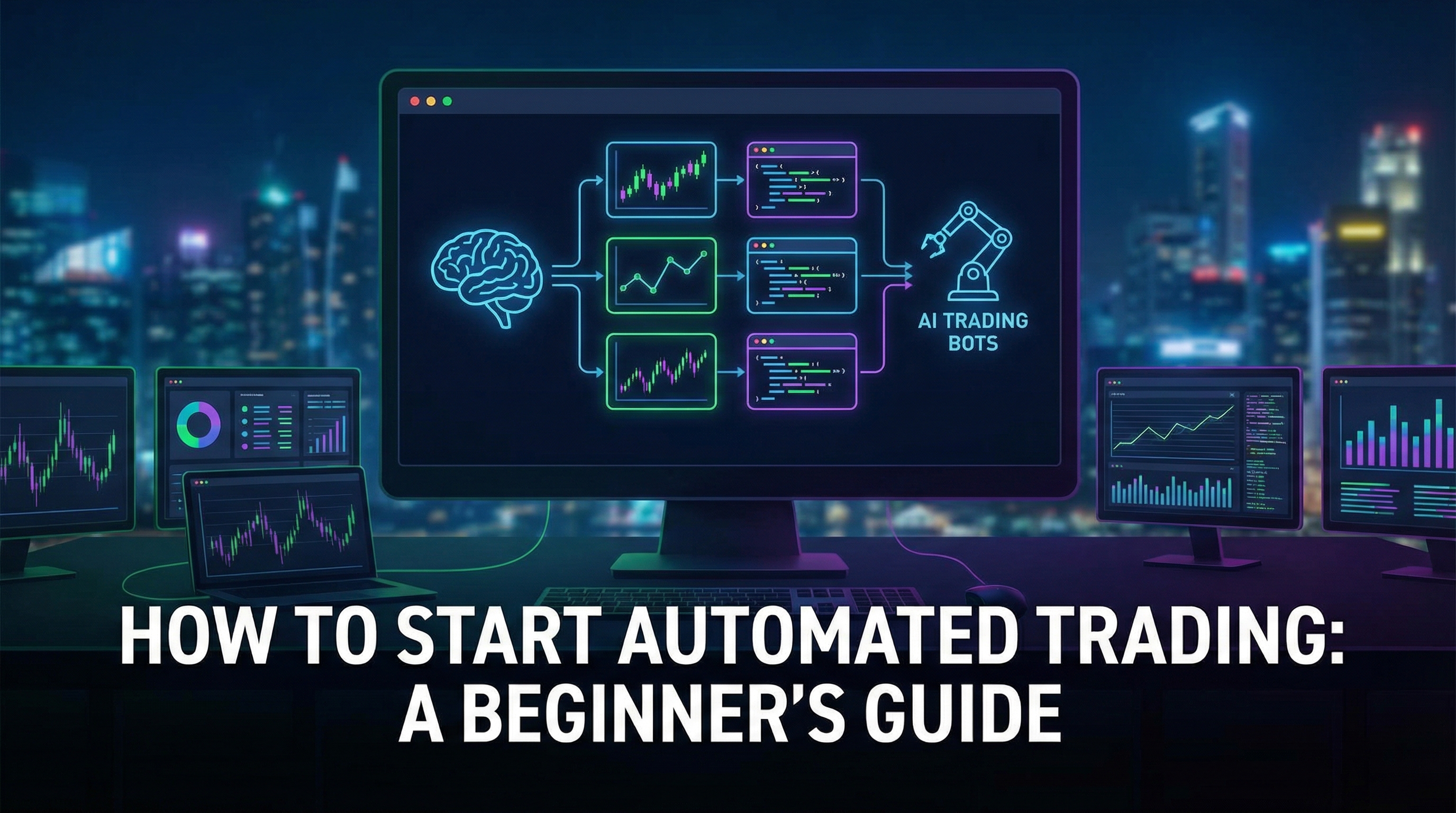
Learn how to start automated trading with this comprehensive beginner's guide. Discover AI trading bots, algorithmic strategies, and smart money tactics.
March 28, 2026 · 8 min read · TradingWizard AI

For decades, the financial markets were a battleground dominated by human intuition, fast reflexes, and floor traders shouting over one another. Today, that world is entirely extinct. Welcome to the era of the machine. If you are wondering how to start automated trading, you are recognizing a fundamental shift in the global financial architecture: roughly 70% to 80% of all market volume is now executed by algorithms.
The "Smart Money"—hedge funds, quantitative trading firms, and institutional market makers—do not trade manually. They leverage sophisticated algorithmic strategies and, increasingly, AI trading bots to execute millions of orders with millisecond precision. For the retail trader, competing against these machines manually is akin to bringing a knife to a gunfight.
However, the democratization of technology in 2024 has leveled the playing field. High-frequency trading infrastructure, machine learning models, and complex AI trading bots are no longer confined to Wall Street server farms. They are accessible to anyone with a computer, an internet connection, and the willingness to learn. This comprehensive guide will walk you through exactly how to start automated trading, demystify AI trading bots, and outline foundational algorithmic strategies you can deploy to protect your capital and extract alpha from the markets.
Before diving into the mechanics of how to start automated trading, it is crucial to understand the tools at your disposal.
Traditional Algorithmic Trading relies on strict, rules-based logic. You (the trader) define the parameters: "If the 50-day moving average crosses above the 200-day moving average, buy 1 unit of asset X. If the RSI drops below 30, sell." The algorithm blindly follows these instructions without emotion, fatigue, or hesitation.
AI Trading Bots, on the other hand, represent an evolutionary leap. Utilizing Machine Learning (ML) and Natural Language Processing (NLP), these bots do not just follow static rules; they learn from the data. They can identify complex, non-linear patterns in market behavior, adapt to changing volatility regimes, and even scrape financial news or social media to gauge market sentiment in real-time.
Whether you choose a simple rules-based script or a complex neural network, the goal remains the same: removing human emotion from the equation and achieving consistent, repeatable, and scalable market execution.
An algorithm is only as good as the data it ingests. In the world of quantitative finance, garbage in equals garbage out. To successfully run algorithmic strategies, your bots need access to high-fidelity, real-time, and historical data streams. Let's break down the three primary data pillars your AI trading bots will rely on.
At its core, technical data involves price (Open, High, Low, Close) and volume. AI trading bots thrive on this data because it can be quantified instantly.
If you are learning how to start automated trading in the cryptocurrency markets, on-chain data is your secret weapon. Unlike traditional equities, blockchains are public ledgers.
Markets do not exist in a vacuum. AI trading bots are increasingly equipped with NLP capabilities to parse macroeconomic data faster than humanly possible.
Transitioning from manual discretionary trading to systematic automation requires a paradigm shift. Here is a practical, step-by-step framework to launch your first automated strategy.
Do not start coding or buying software until you have a crystal-clear thesis. What market inefficiency are you trying to capture?
To execute algorithmic strategies, you need a bridge between your logic and the exchange.
Backtesting involves running your algorithmic strategies against historical market data to see how they would have performed. This is the most critical step, but it is also where beginners make fatal errors.
Once your backtest proves successful (showing a strong Sharpe Ratio and a manageable Max Drawdown), do not risk real capital yet. Connect your AI trading bots to a testnet or use a paper trading account. This proves whether your strategy works in the current market regime with live, tick-by-tick data, without any financial risk.
When you finally flip the switch to live capital, start small. The golden rule of automated trading is that bots require supervision.
To trade like the Smart Money, you must view the market in terms of probabilities and scenarios. What happens when you deploy AI trading bots?
In the bull scenario, your algorithmic strategies successfully navigate market noise. Because the bot trades 24/7, it captures a 3:00 AM breakout in the Asian session that you would have slept through. The emotionless execution means you never "revenge trade" after a loss or get greedy during a win. By compounding small, consistent edges over thousands of trades, your portfolio curve moves steadily up and to the right, freeing up your time to research new strategies rather than staring at charts.
In the bear scenario, a lack of strict risk management leads to disaster. A "Black Swan" event occurs—perhaps an unexpected geopolitical conflict or a sudden exchange hack. Volatility spikes massively. If your bot is running a mean-reversion strategy without a hard stop-loss, it may continually "buy the dip" on an asset going to zero, liquidating your account. Furthermore, API disconnects or cloud server outages could leave you trapped in a position without the bot able to execute its programmed exit. This underscores why "set it and forget it" is a myth; automated trading requires proactive portfolio management.
Learning how to start automated trading is not a get-rich-quick scheme; it is the transition from being a gambler to becoming a systematic quantitative manager of your own wealth. By leveraging AI trading bots and rigorously tested algorithmic strategies, you strip the deadly human elements of fear and greed from your trading.
The data is clear: the future of finance is automated. The only question is whether you will be running the algorithms, or providing liquidity for the algorithms run by someone else.
Ready to trade like the Smart Money? Do not build your infrastructure from scratch. Leverage TradingWizard.ai. Build and deploy sophisticated AI trading bots without needing a PhD in computer science. Utilize our advanced chart analyzer to find your edge, and set up custom market alerts to stay ahead of macro and on-chain shifts. Stop competing against the machines—become one. Join TradingWizard.ai today and automate your edge.
Sep 18, 2026 · 15 min read
Sep 17, 2026 · 12 min read
Sep 16, 2026 · 11 min read
Sep 13, 2026 · 13 min read
14 days free. No card.
Trading involves risk. Bots trade a Demo account with simulated money. Nothing here is investment advice.