


MacroSep 28, 2026 · 11 min read

Learn how to start trading with this comprehensive step-by-step guide for beginners. Master risk management, technical analysis, and build a winning strategy.
TradingWizard AI9 min read

We are living in an era of unprecedented financial democratization. Historically, the tools, data, and execution speeds required to extract alpha from the financial markets were locked behind the velvet ropes of Wall Street, accessible only to institutional hedge funds and proprietary trading desks. Today, the landscape has fundamentally shifted. If you are researching how to start trading, you are entering a market environment where retail participants have access to institutional-grade analytics, zero-commission brokers, and advanced algorithmic tools.
However, this democratization of access has also led to a democratization of risk. The markets are more volatile, interconnected, and ruthless than ever before. Trading is not a path to overnight wealth; it is a highly competitive, high-performance endeavor. It is a business of probabilities, risk management, and psychological fortitude.
In this comprehensive step-by-step guide for beginners, we will strip away the noise and the 'get-rich-quick' fallacies. We will approach the markets through the lens of 'Smart Money'—focusing on capital preservation, data-driven execution, and systemic consistency. Whether you are looking at equities, forex, or cryptocurrencies, mastering how to start trading effectively is the ultimate meta-skill for financial independence.
Before executing your first trade, you must understand the mathematical reality of the arena you are entering.
Industry statistics frequently cite the "90/90/90 rule"—suggesting that 90% of new retail traders lose 90% of their capital within their first 90 days. While the exact metrics vary by asset class and broker, regulatory data from the European Securities and Markets Authority (ESMA) consistently shows that between 70% and 85% of retail accounts lose money trading CFDs and derivatives.
Why? The data points to three primary culprits:
To be in the profitable minority, your approach on how to start trading must be anchored in data. Markets are driven by two primary forces: Macro-economics (liquidity, interest rates, geopolitics) and Micro-mechanics (order flow, technical levels, supply and demand imbalances).
Currently, we are navigating a complex macro environment characterized by shifting central bank policies, fluctuating global liquidity, and high geopolitical tension. 'Smart Money' tracks these macro factors diligently. When liquidity is expanding, risk assets (like tech stocks and crypto) generally thrive. When liquidity contracts, capital rotates into defensive assets. A successful beginner must understand that technical analysis dictates when to enter a trade, but macro analysis dictates why the market is moving in a certain direction.
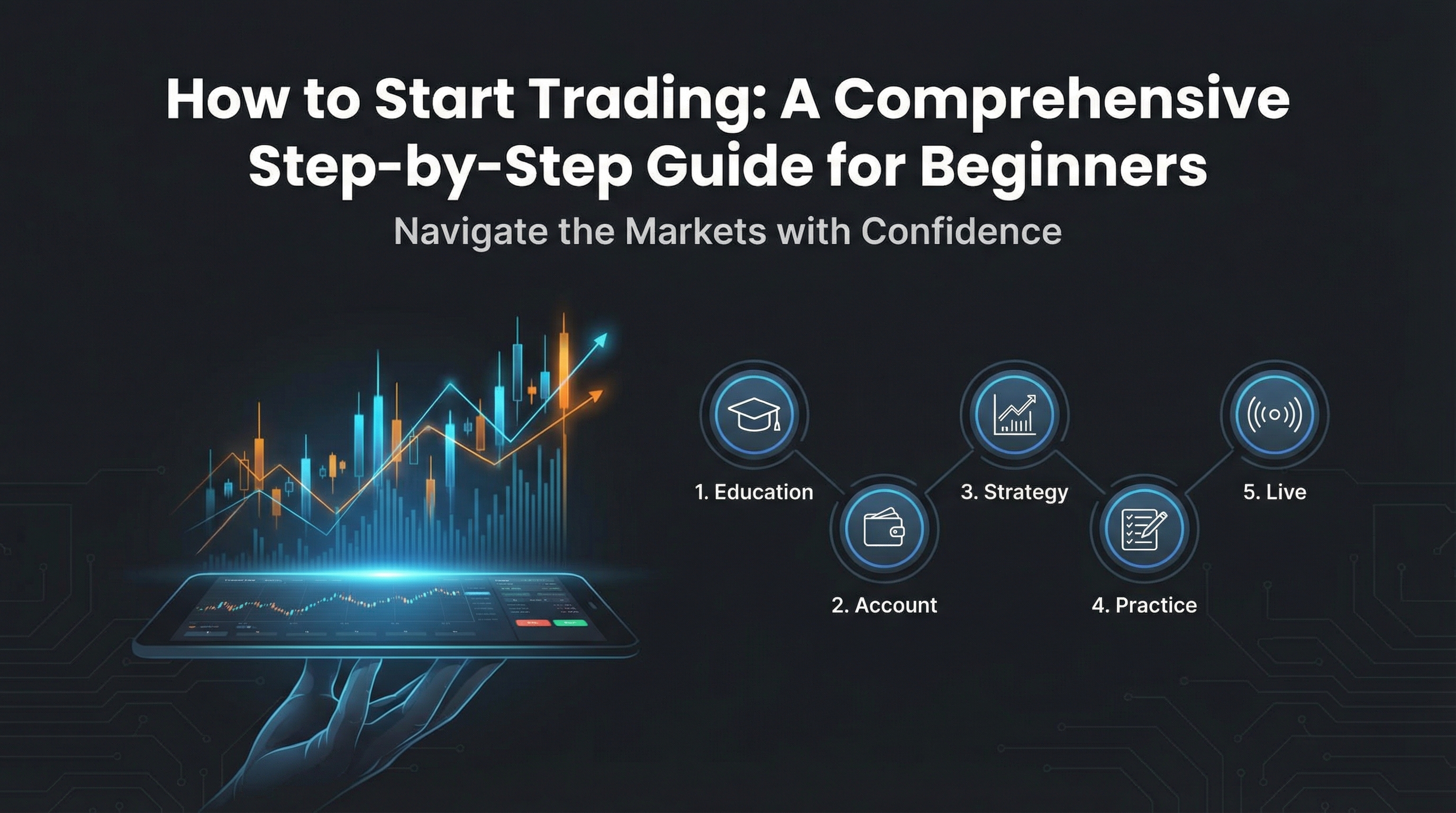
Transitioning from an observer to a profitable market participant requires a structured, systemic approach. Follow these foundational steps.
The financial markets are vast, and there is no single "correct" way to trade. Your strategy must align with your personality, schedule, and capital.
Selecting the right market is a critical component of how to start trading successfully. Each asset class has unique characteristics:
Once you choose your market, select a broker that offers low fees, deep liquidity, fast execution, and a robust API (Application Programming Interface) if you plan to use automated tools later.
If you take only one lesson from this beginner trading guide, let it be this: Trading is not about making money; it is about protecting money.
Professional traders think in terms of risk, while amateurs think in terms of reward. To survive, you must master the mathematical concept of Expected Value (EV).
The 1% Rule:
Never risk more than 1% to 2% of your total account capital on a single trade. If you have a $10,000 account, your maximum risk per trade should be $100. This does not mean you only buy $100 worth of an asset. It means that the distance between your entry price and your stop-loss (the price at which you exit a losing trade) should equal a $100 loss.
Risk-to-Reward Ratio (R:R):
Every trade should offer an asymmetric risk-to-reward ratio. A standard professional benchmark is 1:2 or 1:3. If you risk $100 (1R), your target profit should be at least $200 (2R) or $300 (3R).
If you strictly adhere to a 1:2 R:R ratio, you only need to be correct on 33% of your trades to break even. This mathematical edge is how 'Smart Money' remains profitable even when facing a string of losses.
Understanding how to start trading requires learning the language of the markets: Technical Analysis (TA) and Fundamental Analysis (FA).
Fundamental Analysis: This is the study of the underlying forces driving an asset's value. In stocks, it involves analyzing balance sheets, earnings reports, and P/E ratios. In macro, it involves tracking CPI (inflation) data, GDP growth, and Federal Reserve dot plots. In crypto, it involves analyzing active addresses, network fees, and tokenomics.
Technical Analysis: This is the study of price action and volume on a chart to identify patterns and probabilities. Key concepts beginners must learn include:
Your goal is to find "confluence"—multiple technical and fundamental signals aligning at the same time to create a high-probability trade setup.
Once your strategy is defined, you must execute it flawlessly. Beginners often fail here due to emotional interference. Fear causes traders to exit winning trades too early, while hope causes them to hold onto losing trades too long.
To combat this, you must keep a Trading Journal. Document every single trade: the date, the asset, the setup, the entry price, the stop-loss, the take-profit, and most importantly, your emotional state at the time of execution. By reviewing your journal weekly, you will identify your psychological blind spots and statistical errors. You cannot optimize what you do not measure.
To provide realistic expectations, let's look at the probabilistic outcomes for a beginner's first year of trading.
In the optimal scenario, the beginner trader approaches the market with extreme humility. They spend the first three months paper trading (simulating trades without real money) to test their strategy. When they transition to live capital, they strictly adhere to the 1% risk rule.
In this highly probable scenario, the beginner is motivated by greed and impatience. They skip paper trading and fund an account with money they cannot afford to lose.
The takeaway: The difference between the bull and bear case is not intelligence or luck; it is strictly discipline and risk management.
Learning how to start trading is not a weekend project; it is a lifelong pursuit of continuous improvement. The markets are an ever-evolving puzzle, and staying ahead requires adapting to new data, managing your psychology, and utilizing the best technological tools available.
As a beginner, your immediate focus should be survival. Protect your capital at all costs, study the macro and micro structures of the market, and treat trading as a disciplined business rather than a casino.
However, you do not have to walk this path alone. The 'Smart Money' relies on automation and artificial intelligence to remove emotion and identify edges faster than humanly possible. This is where TradingWizard.ai comes in.
By leveraging our institutional-grade toolkit, you can drastically shorten your learning curve:
Ready to trade like the top 10%? Stop guessing and start analyzing. Sign up for TradingWizard.ai today and unlock the tools you need to build a profitable, data-driven trading business.
MacroSep 28, 2026 · 11 min read
MacroSep 25, 2026 · 12 min read
MacroSep 23, 2026 · 15 min read
MacroSep 21, 2026 · 12 min read