



MacroOct 14, 2026 · 9 min read

Discover how Smart Money uses AI trading bots to eliminate emotional bias. Explore live, data-driven setups across GBPJPY, NDX, SOL, and ETH.
TradingWizard AI4 min read
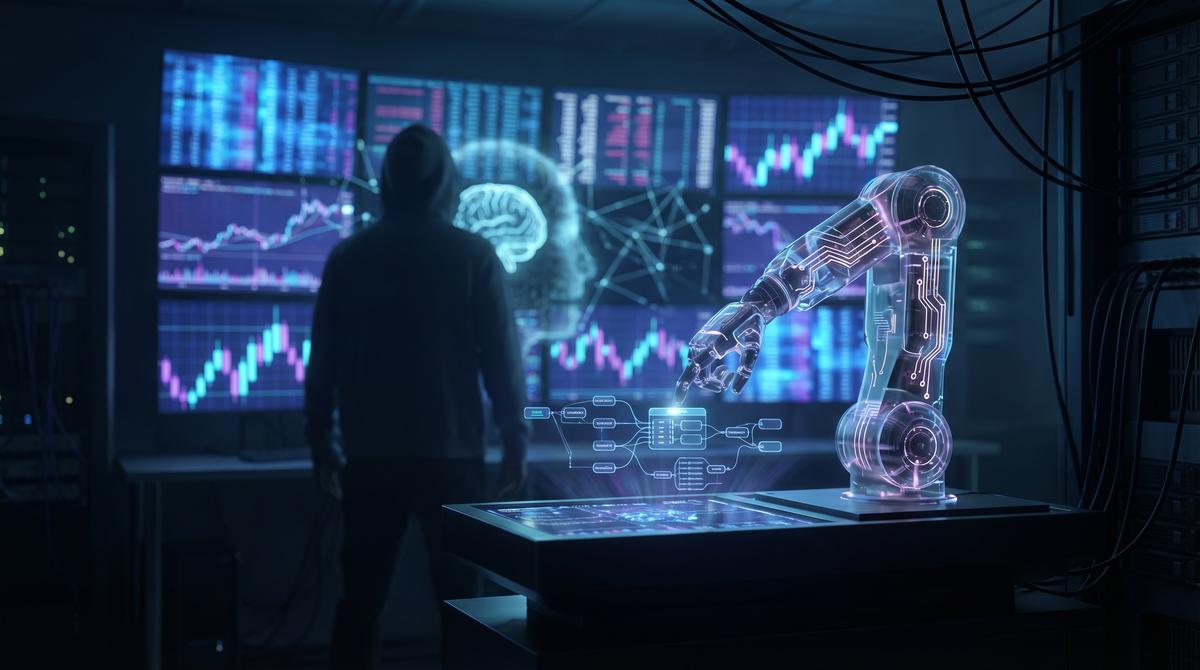
In the high-stakes arena of financial markets, the greatest adversary you face is not the algorithm on the other side of the trade—it is your own psychology. Fear of Missing Out (FOMO), revenge trading, and panic selling are the psychological friction points that erode retail portfolios. While human traders hesitate, second-guess, and let cognitive biases dictate their risk management, Smart Money relies on cold, hard data.
As we navigate the current macroeconomic cycle—characterized by cross-asset volatility and rapid liquidity shifts—the need for systemic, emotionless execution has never been more critical. This is where AI trading bots step in. By automating your strategy with sophisticated artificial intelligence, you strip away the psychological vulnerabilities and replace them with probabilistic precision.
Let’s explore how the TradingWizard.ai engine processes complex market data in real-time, executing high-probability setups that human traders often miss due to emotional fatigue.
To understand the power of automated AI execution, we must look at how an algorithm strips away the "noise" and focuses entirely on technicals, macro context, and wave structures. Below are real-time, active setups generated by our AI bots—demonstrating how machine learning interprets live price action without hesitation.
Human traders often falter in traditional markets due to macro-economic news anxiety. The AI, however, trades the chart's reality.
Crypto markets operate 24/7. Fatigue is a human trader's worst enemy here, leading to missed entries or late capitulations.
An AI does not predict the future; it reacts to probabilities based on historical data and current structure. By viewing the market through a probabilistic lens, you protect your capital from devastating drawdowns.
In assets like GBPJPY and FET, the AI identifies institutional accumulation (Smart Money flow) at key Fibonacci retracements (the Golden Zones). The probability of a successful Wave 3 impulse is historically higher when these levels are defended. The AI's high confidence scores (82%-88%) indicate that multiple confluence factors (volume, trend structure, RSI) align with the bullish scenario.
Conversely, assets like NDX and SOL present strong bearish scenarios. A human trader might try to "catch the falling knife" on SOL at $82.65, but the AI recognizes the 0.618 Fib rejection as a high-probability distribution marker. By shorting the retest of broken support (as seen in the NDX setup), the AI ensures the risk-to-reward ratio is mathematically optimized before capital is deployed.
The era of manual, discretionary trading is rapidly being overshadowed by systemic, automated execution. As demonstrated by the live TradingWizard.ai setups, AI bots do not succumb to fear when NDX breaks critical support, nor do they FOMO into ETH before a proper retest of 2165.
By automating your strategy, you are not surrendering control—you are upgrading your execution. You elevate yourself from a reactive participant to a portfolio manager, letting the algorithms handle the heavy lifting of technical analysis and trigger-pulling. Eliminate your emotional bias, trust the data, and trade like Smart Money.
MacroOct 14, 2026 · 9 min read
MacroOct 9, 2026 · 13 min read
MacroOct 7, 2026 · 13 min read
MacroOct 5, 2026 · 13 min read