



Macro
Fed Rate-Path Repricing: How U.S. Labor Data Changes the Trade
Sep 18, 2026 · 15 min read
Master the modern financial markets. Discover how to build a quantitative edge, manage risk, and automate your strategies with AI trading bots.
March 27, 2026 · 8 min read · TradingWizard AI

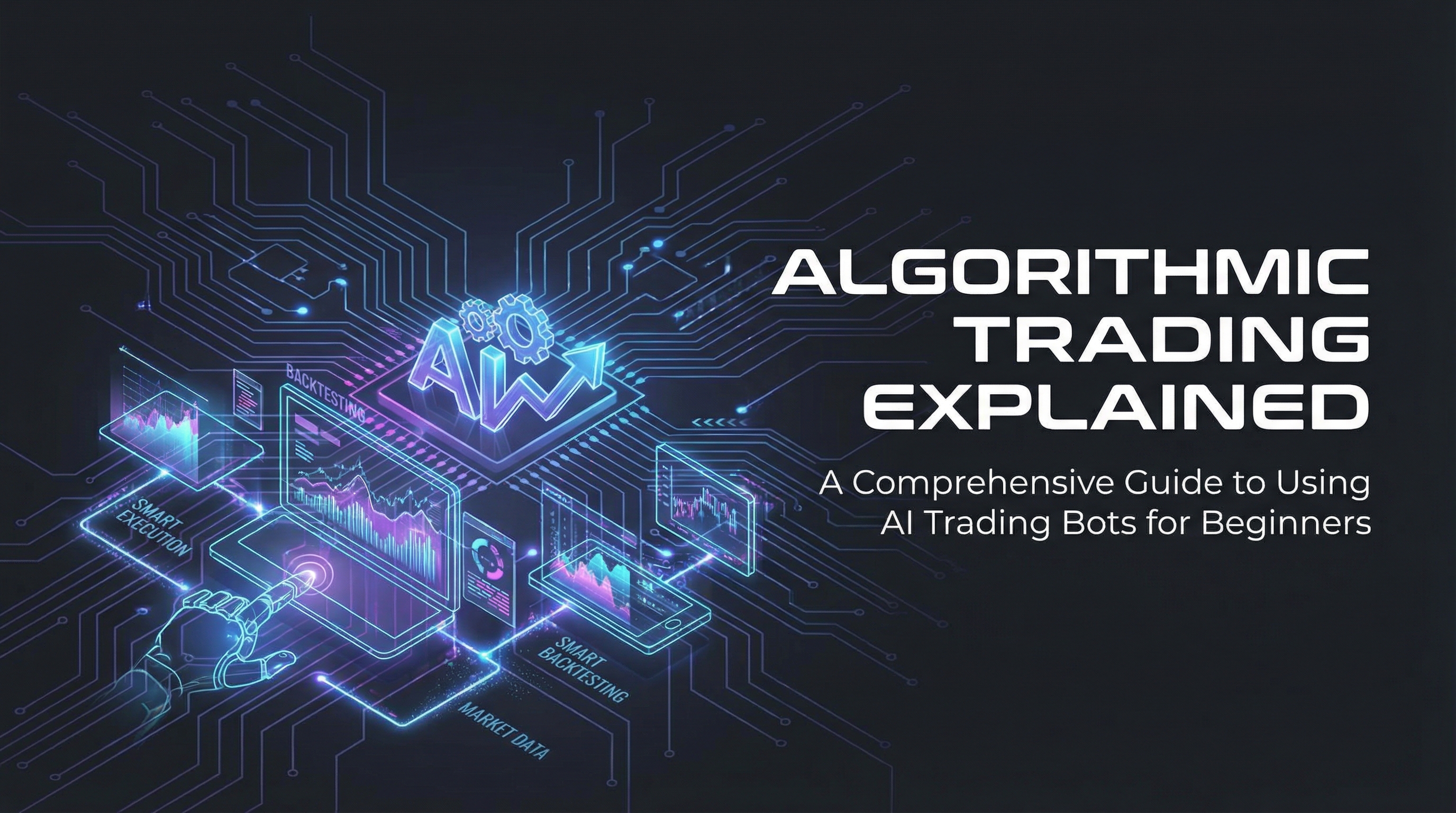
The financial markets have undergone a quiet but absolute revolution. The days of pit traders shouting orders across a bustling exchange floor are long gone. Today, the market is a highly efficient, hyper-fast digital arena dominated by cold, calculating machines. If you are a retail trader manually executing trades based purely on emotion or delayed chart reading, you are competing against supercomputers that process millions of data points per second. Welcome to Algorithmic Trading Explained: A Comprehensive Guide to Using AI Trading Bots for Beginners. In this definitive guide, we will bridge the gap between institutional "Smart Money" and retail ambition, showing you exactly how automated trading systems work, how to build a quantitative edge, and how to deploy artificial intelligence to execute your market thesis flawlessly.
To understand why algorithmic trading is no longer just an option but a necessity, we must look at the structural reality of modern liquidity. Over 80% of daily trading volume in equities, forex, and cryptocurrency markets is executed by algorithmic systems. Hedge funds, market makers, and proprietary trading firms utilize high-frequency trading (HFT) and complex statistical arbitrage models to extract alpha from the market.
For a long time, the barrier to entry was insurmountably high for retail traders. Building an algorithmic trading system required a Ph.D. in applied mathematics, enterprise-grade server racks co-located at the exchange, and millions of dollars in capital.
Today, the democratization of Artificial Intelligence (AI) and the rise of retail-friendly APIs have leveled the playing field. Cloud computing, open-source machine learning libraries, and no-code bot platforms have made it possible for beginners to harness the power of automation.
Why does this matter now? Because the velocity of the market is increasing. The recent integration of Large Language Models (LLMs) and neural networks into trading has created a paradigm shift. Bots are no longer just executing "If/Then" technical rules; they are analyzing real-time global news sentiment, scraping blockchain mempools for institutional block trades, and dynamically adjusting risk profiles based on macro-economic volatility. If you are not learning how to use these tools, you are effectively trading blindfolded against a grandmaster.
At its core, algorithmic trading is the process of using pre-programmed instructions—or dynamically learning AI models—to execute trades based on specific variables such as price, timing, and volume. To build a successful AI trading bot, you must feed it the right data. A bot is only as intelligent as the data stream it ingests.
Let's break down the three primary pillars of data that "Smart Money" bots rely on to generate consistent alpha.
Most beginner AI trading bots start by parsing Technical Analysis (TA). However, unlike a human trader who might "feel" that a trend is reversing based on a chart pattern, a bot calculates momentum through strict mathematical variance.
In traditional finance, traders must wait for quarterly earnings reports or delayed institutional 13F filings. In the cryptocurrency market, the blockchain provides a real-time, transparent ledger of every single transaction. AI bots leverage this on-chain data to front-run retail panic and shadow institutional accumulation.
The most sophisticated evolution in AI trading bots is Natural Language Processing (NLP). Markets are deeply sensitive to macroeconomic data, such as inflation reports, interest rate decisions, and geopolitical events.
For beginners looking to transition into algorithmic trading, follow this exact "Smart Money" blueprint:
No algorithmic system is foolproof. Understanding the probabilities of success and the potential for catastrophic failure is what separates professional quants from novice gamblers.
Probability of Success: High (Assuming rigorous backtesting and strict risk management)
In optimal market conditions, an AI trading bot represents the ultimate trading vehicle. The bull case for algorithmic trading rests on the elimination of human emotion. A bot does not suffer from FOMO (Fear of Missing Out), nor does it panic-sell at the exact market bottom.
Probability of Failure: Significant (If deployed without human oversight and hard stops)
Algorithmic bots are highly specialized tools. A bot built to trade a calm, ranging market will be absolutely decimated if a sudden, violent macro trend emerges. This is known as a "Regime Shift."
The Solution: The "Smart Money" approach is not fully autonomous trading, but Centaur Trading—human oversight paired with AI execution. A human sets the macro thesis and the absolute risk limits (a portfolio-wide kill switch), while the bot handles the micro-execution.
The transition from manual trading to algorithmic automation is the most profitable leap a retail trader can make. By removing the psychological friction of trading and replacing it with data-driven, backtested AI systems, you transition from gambling on price action to operating a statistical business.
However, building an algorithmic edge requires the right infrastructure. You need clean data, robust charting, and flawless execution to compete with institutional players. You don't need a Ph.D. to succeed anymore, but you do need the right toolkit.
This is where TradingWizard.ai bridges the gap.
Stop letting your emotions dictate your portfolio. Utilize TradingWizard's AI Trading Bots to automate your most profitable setups with zero coding required. Use our deep-dive Chart Analyzer to backtest your technical thesis against decades of market data, and set up our Smart Alerts to get instantly notified of critical on-chain movements and macro data prints before the rest of the retail market reacts.
The machines have already taken over the market. It is time you put them to work for your own portfolio. Upgrade your edge today at TradingWizard.ai.
Sep 18, 2026 · 15 min read
Sep 17, 2026 · 12 min read
Sep 16, 2026 · 11 min read
Sep 13, 2026 · 13 min read
14 days free. No card.
Trading involves risk. Bots trade a Demo account with simulated money. Nothing here is investment advice.